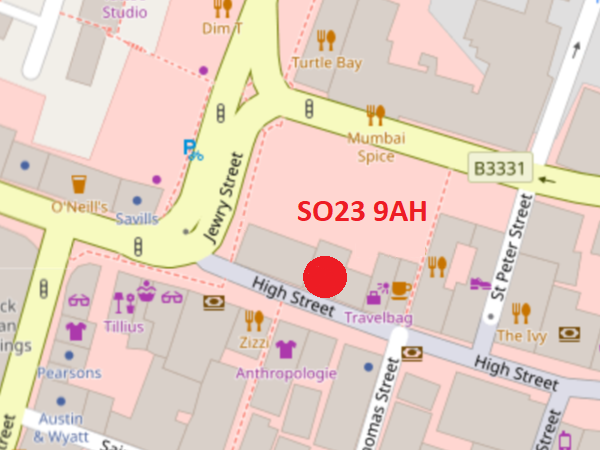
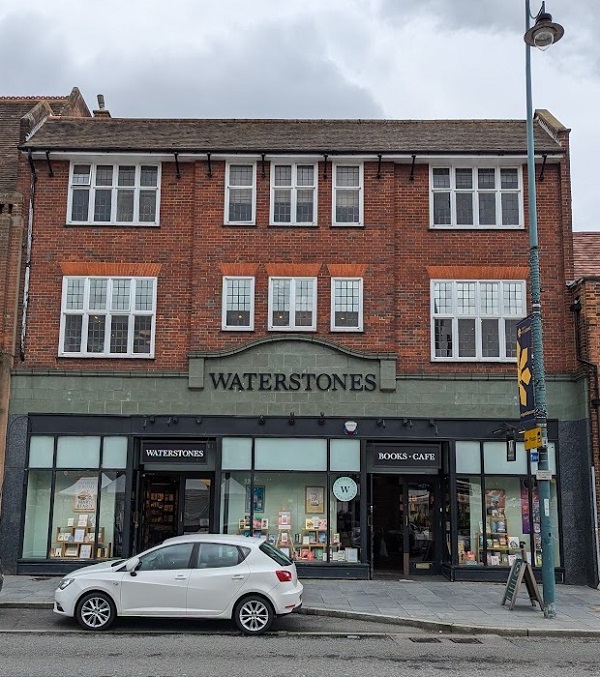
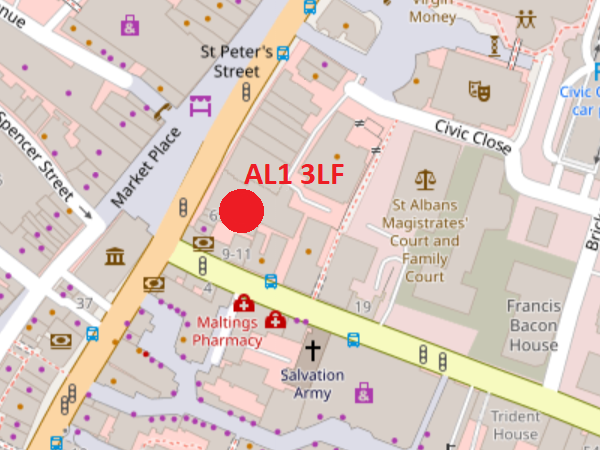
WE’VE FINISHED!

We’ve now visited every Waterstones and Hatchards in mainland Great Britain currently listed on the Waterstones store locator (plus Foyles) – with the exception of the two new Waterstones inside John Lewis branches. We may pick those up one day. When Waterstones acquired Blackwell’s in February 2022, we chose not to include those shops, as it would have meant travelling back north to places we’d already visited. Altogether, we’ve visited 312 shops.

The journey began on Saturday 10th June 2017 with a trip to Bridport. The whole idea started with a throwaway comment from Hayley, a friend from a book forum. I’d mentioned popping into yet another branch and she said, “You should visit them all!” What began as a joke between my husband Peter and me slowly turned into a real quest.

I had originally planned to visit every branch everywhere, but we realised we’d never truly finish – branches keep opening (which is wonderful!). We have visited some of the non-mainland shops and will probably revisit Northern Ireland, the Republic of Ireland and Amsterdam. We may even make it to the Isle of Man. But after we visited Berlin earlier this year, we decided to stop now; the world is big, and we want to explore more of Europe.

For more than eight years, we’ve planned all our holidays around visiting Waterstones shops, and it has been brilliant. We’ve travelled to places we never would have seen otherwise and discovered wonderful things along the way. I’ve used Wikipedia and various tourist sites for research, but all posts are written in my own words. I’m not much of a writer, but I hope the blog gives a real sense of the places we’ve been. It’s certainly evolved over time – the early posts focused only on the shops, not the wider locations.

My favourite Waterstones is probably the Bradford branch, housed in the stunning Victorian Wool Exchange that looks like a cathedral. But there are plenty of other beautiful buildings too – Reading’s former chapel and Swansea’s old cinema, to name just two.

This journey has taken us north, south, east and west. The furthest shop from home was in Elgin, Scotland (now closed), a full 557 miles away. The whole quest has been an absolute blast. 

And at the risk of sounding like an awards-ceremony speech, I really do want to thank Hayley for the original suggestion, my good friend Tracy, who has followed my journey on WordPress and liked and commented on nearly every post – your support means so much, and to the other friends who have also made appearances. Finally, a huge thank-you to my husband Peter, who has accompanied me on most of these trips, and who “does a Hitchcock” by appearing in many of the photos. Thank you for all the driving!

Glasgow – Byres Road – Saturday 6th September 2025

Glasgow is Scotland’s biggest city, known for its friendly people, vibrant music and arts scene, and mix of historic and modern architecture. We visited on a day trip back in 2019, but only really scratched a very small surface, so we decided to spend five nights here after leaving Edinburgh.  We had a great time and really loved the city.  There are three Waterstones in the city of Glasgow – we did the one in Sauchiehall Street and Argyle Street ones during our earlier visit.  This time we visited the one at Byres Road, which opened in 2015.  We walked there from our hotel and loved the area. The Waterstones is in an attractive red sandstone building, part of Grosvenor Mansions, built in 1931.  I am going to share lots of pictures covering the time we were in Glasgow, so there will be plenty of pictures – do take a look if you have time!

Glasgow Botanic Gardens

The Botanic Gardens opened in their present location in 1842 and feature several glasshouses, included the one pictured below, Kibble Palace, which was erected in 1873.  It houses a great number of different plant species, and includes koi carp pond and a section devoted to carnivorous plants!

Riverside Museum

The Riverside Museum is Glasgow’s award-winning transport museum, free to visit and home to a fascinating collection of cars, bicycles, trams, trains, model ships, and much more. Opened in 2011, it’s a must-see for visitors of all ages.  We spent a couple of hours here.

Kelvingrove Museum and Art Gallery

The Kelvingrove Art Gallery and Museum opened in 1901 and features around 800 exhibits spread across 22 galleries. The star of the collection is arguably Salvador Dalí’s Christ of Saint John of the Cross, acquired in 1952 for £8,200 – a controversial purchase at the time, which even faced a public petition against it. Since then, it has been vandalised twice, but still draws a crowd. There was quite a queue to see it when I visited, but it was well worth the wait. Entry to the museum is free, and the building itself is a masterpiece – never mind the many treasures inside. Peter left me to explore at my own pace, and I happily lost several hours there.

Glasgow Tenement

Cared for by the National Trust for Scotland, 145 Buccleuch Street is a preserved tenement flat that once belonged to Miss Agnes Toward, a dressmaker who lived and worked there from 1911 to 1965. Known for her frugality and reluctance to throw anything away, Agnes left behind a remarkable time capsule of mid-20th-century life. Visitors can explore four original rooms – the kitchen, parlour, bedroom, and bathroom – all faithfully preserved. There’s also an exhibition space on the ground floor, spread across two additional rooms. We found it to be very interesting. 

Glasgow City Chambers

Designed by William Young and completed in 1888, the City Chambers is one of Glasgow’s most ornate buildings, known for its opulent interiors. Highlights include grand marble staircases, intricate mosaics, a stunning Banqueting Hall, and the richly decorated Council Chamber, lined with Spanish mahogany. Free guided tours run on weekdays (unless the building is in use), with tickets available on a first-come, first-served basis half an hour before each tour. We were lucky to get spots on a morning tour. Although we were warned that access might be limited due to meetings, we were delighted to be shown into the Council Chamber after all, just before a session began. The building is absolutely breathtaking — well worth a visit.

Glasgow Cathedral

St Mungo’s Cathedral is the oldest cathedral in mainland Scotland and was consecrated in 1197. The pews or chairs have been taken out of the main nave (the section before the quire screen) – presumably for use as some sort of performance space, but the section behind the quire has pews, and I imagine this is where the services now take place. 

The Hill House

The Hill House, located about 30 miles northwest of Glasgow, was designed by the renowned Scottish architect and artist Charles Rennie Mackintosh, in collaboration with artist Margaret Macdonald. Commissioned by Glasgow-based publisher Walter Blackie, the house was both designed and decorated by the pair to reflect their distinctive style. Now managed by the National Trust for Scotland, who took over in 1984, the interior is beautifully preserved and truly stunning. The exterior, however, has suffered some weather-related damage and is currently undergoing restoration. As part of the conservation effort, a protective structure – complete with a viewing platform – has been built over the entire house, allowing visitors to walk above it. We were lucky enough to visit while it was in place and got a fantastic bird’s-eye view!

Glasgow Shots

Various views from the Central Lowlands of Scotland

Chichester – Monday 30th December 2024

Chichester is a Roman city and the county town of West Sussex. The Romans, who called it Noviomagus Reginorum, chose the location to build their town as it had good access to the sea, which allowed them to easily receive supplies from France and made it the perfect place for trade.  The Waterstones is located in a grade 2 listed building which was part of the Dolphin and Anchor hotel – the ballroom upstairs still has its chandelier from hotel days!

Chichester is also a Cathedral city, being home to the Cathedral Church of the Holy Trinity which was consecrated in 1108.  The Cathedral is home to some Roman remains which can be seen via a viewing panel in the floor.

The photos below, are: Shippams (2) – the well-known paste company was established in Chichester in 1786, but was sold in 1974.  When the factory was demolished, the facade was left.

Chichester Market Cross (1746) and The Buttermarket (1808)

The Council House (1731) and John Keats statue – the poet stayed in Chichester in 1819.

Currently reading Mr Dickens and His Carol by Samantha Silva        


Winchester, High Street – Friday 11th October 2024

The second Waterstones in Winchester is located in an attractive two-storey shop in the High Street, but I have been unable to find out the history of the building, although from the mosaic tiling at the entrance, it was once a branch of Hatchard’s Booksellers. 

Winchester High Street 11th October 2024 (1)

Winchester High Street 11th October 2024 (1)

The Winchester Bollard Project

Since 2005 there has been an ongoing project to decorate bollards in the city.  Starting with 16, there are now apparently 28 bollards, but we only had time to spot a few as we didn’t have much time left on our parking, but some of them were being touched up, so it’s good that they’ve lasted so long.  Here are three – Da Vinci’s Mona Lisa, one celebrating Winchester’s Roman heritage and one for Queen Elizabeth II’s Diamond Jubilee in 2012.

Various shots of Winchester

Top row  – Winchester Guildhall, built 1875.  An ornate clock on the Lloyds bank building.
Middle row – Ghost signs for Nestle Milk on a former shop.  A channel of the river Itchen located in Abbey Gardens.
Bottom row – Winchester’s Coat of Arms.  The statue of King Alfred the Great. 


Winchester, The Brooks – Friday 11th October 2024

Winchester is a cathedral town in Hampshire which was, once upon a time, the capital of Wessex and the seat of King Alfred the Great, for whom there is a statue in the town.  Today, remnants of Winchester’s historical significance are everywhere, from its preserved medieval walls to the mighty cathedral that dominates the skyline.  It is also home to Winchester College, the oldest public school in the country.  There are two Waterstones in Winchester. The first we visited is located in a modern shop in the Brooks Shopping Centre.

Winchester The Brooks Map

Winchester Cathedral

The city’s Gothic cathedral, which was built between 1079–1532, is one of the largest in Europe with the longest nave in England, and the author Jane Austen is buried there.  The cathedral came within the brink of collapse in the early 1900s, but was saved when a diver called William Walker carried out repairs on the foundations of the cathedral to stop it from sinking into the ground.

Borrowed Breath

Some of the pieces from an exhibition called Borrowed Breath by sculptor Laurence Edwards, part of a set of fifteen inspired by Winchester Cathedral’s west window.

Currently reading:  Frankie by Graham Norton

Aberystwyth – Thursday 5th September 2024

Aberystwyth is a historic coastal town in mid Wales known for its spectacular sunsets and winter storms.  It’s a university town and a popular holiday destination.  The town has a mile-long Victorian promenade with a sweeping dark sandy beach.  It also has a funicular railway and a pier.  The Waterstones is located in the centre of town – I haven’t been able to find out the history of the building.

PXL_20240905_153652769

Aberywtwyth map

Aberystwyth Cliff Railway

Aberystwyth is home to the longest electric funicular cliff railway in Britain.  It opened in 1896, and carries passengers from the base of Constitution Hill to its summit, offering breathtaking panoramic views of the town and the surrounding coast.  We were here on a really hot day, so we were happy to find a café at the top serving beer and ice cream!

National Library of Wales / Llyfrgell Genedlaethol Cymru

The National Library of Wales was established in 1907 and is the largest library in Wales – it holds around 6.5 million books and magazines.  It’s a beautiful building inside and out, and the North Reading Room is especially attractive.  It’s open to visitors, so we popped in to take a look. 

Aberystwyth

Currently reading: Rainbow Valley (Anne of Green Gables #7) by L M Montgomer

St Albans – Wednesday 10th July 2024

St Albans is a cathedral city in Hertfordshire which was known as Verulamium when the Romans occupied it.  Its name comes from the first British saint, Alban. After the Romans left in 410 AD, the bricks from their ruined buildings were used as building materials for the new town of St Albans and the cathedral.  The town was granted city status in 1877.  The Waterstones is located in the main shopping area in a three-storey read bricked building.  Sadly I haven’t managed to find anything about the building’s history.

St Albans 10th July 2024 (1)


St Albans

Cathedral and Abbey Church of St Alban

St Albans Abbey was founded in Norman times but ceased to be an Abbey after the Dissolution of the Monasteries in the sixteenth century.   It was made a cathedral in 1877 and has the longest nave of any English cathedral at 85 metres in length.  I found the nave to be restful and quite simple in its décor, but behind that, the rest of the cathedral is packed with exquisite and colourful features. 

Sudbury – Monday 8th July 2024

Sudbury in Suffolk is a medieval market town on the River Stour.  The English artist Thomas Gainsborough was born in the town in 1727 and there is a museum dedicated to him.  Sadly, we arrived quite late in the day, so we didn’t have time to do much exploring, but from what we saw it’s a pretty town.  The Waterstones opened in November 2023 and is located on the site of an old hotel called The Four Swans, which burnt down in 1997.  The hotel building was severely damage, and had to be demolished, and when rebuilt as shops, the design was made to look similar to the former hotel.   You can see a photo of the original building on this site.

PXL_20240709_145258730.MP

Sudbury map

Lavenham Guildhall

On our way to Sudbury (when the weather was nicer!) we stopped at Lavenham to visit the old Guildhall, which is now owned by the National Trust.   Built in the early 16th century for the Guild of Corpus Christi, this was one of four medieval guilds in Lavenham.  The decline in the woollen cloth trade saw the building repurposed as a prison, and then later a workhouse. It passed into NT ownership in 1951.  

Thomas Gainsborough’s house, and his statue in the town

The Thomas Gainsborough House picture above  is by John Firth, CC BY-SA 2.0

Leicester – Sunday 7th July 2024

Leicester is a diverse city in the East Midlands, which is possibly best known as the location where English King Richard III’s remains were discovered under a car park in 2012.  They were reburied in Leicester Cathedral three years later.  The city is also home to one of the oldest and largest outdoor covered markets in Europe, but unfortunately it wasn’t open the day we were there.  During the Industrial Revolution, hosiery, textiles, and footwear became the major trades and Leicester was granted city status in 1919.  The Waterstones is located in the Highcross Shopping Centre in the heart of the city.

Leicester map

Leicester Cathedral

The original Church of Saint Martin, Leicester was built around the year 900 and was rebuilt and enlarged between the 13th and 15th centuries.  More restoration work took place in the 1800s and it was made a cathedral in 1927.  It’s the final resting place of King Richard.  

Richard III’s Grave

Richard III Visitor Centre

Opposite the cathedral is the visitor centre, which was built over the area where the King’s remains were discovered.  The original position of the skeleton is projected onto the ground, as shown outlined in red in my photo below.

Guildhall Museum

The museum is a timber framed building, the oldest part of which was built in the late 14th century.  It’s free to visit, and I popped in on my way between the cathedral and the visitor centre. The Great Hall was closed for an event, but the rest of the building was very interesting.

The New Walk

New Walk is a Georgian pedestrian promenade which was established in 1785 and is around a mile long.  It’s very tranquil, as bikes and scooters are banned (although we did see a few!). It is a conservation area so that the character is preserved.

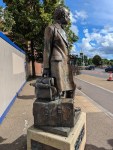
Below – Row 1. Abbey Pumping Station Museum. Row 2. Leicester Town Hall. Row 3. Statue of Thomas Cook, who began his travel company with a trip from Leicester station.

Currently reading:  The Survivors by Jane Harper and Standing in the Shadows by Peter Robinson

Bath – Saturday 29th June 2024

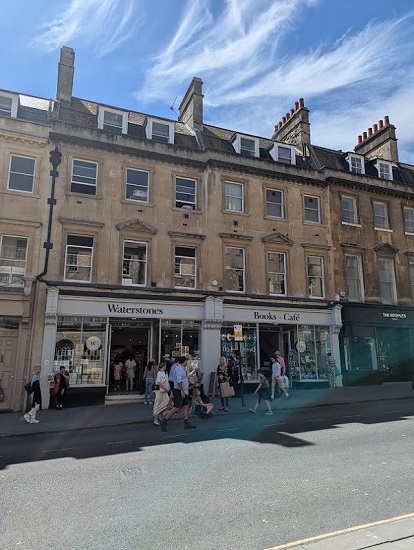
Bath is a city in Somerset renowned for its rich history, stunning architecture, and natural hot springs.   It has been a UNESCO World Heritage site since 1987. It was established as a Spa town by the Romans, and named by them as Aquae Sulis.  Bath experienced a boom in popularity in the 18th century, leading to the construction of many Georgian buildings. The Royal Crescent, the Circus, and Pulteney Bridge are iconic examples of this elegant architectural style.  Lots of authors have made Bath their home over the years, and the most famous of these must surely be Jane Austen. Her novels Northanger Abbey and Persuasion are both set in the city.  There are many attractions in the city which means it’s exceptionally popular with tourists.  The most famous are the Roman Baths, Bath Abbey, The Royal Crescent and The Circus and the Bath Thermae Spa, but there are many other reasons to visit.  It’s also the home to one of my closest branches of Waterstones!  The shop, which is set over three floors, is located at numbers 4-5 Milson Street.  It was originally two houses – part of a whole row (numbers 2-22) of large townhouses – and is Grade II Listed.  It opened as a Waterstones in the 1980s.

Bath 28 Jun 24 (1)

Bath map

The Circus and the Royal Crescent

The Circus is one of Bath’s most iconic architectural masterpieces, designed by John Wood the Elder and completed by his son (John Wood the Younger) in 1768. This sweeping crescent – a shaped row of 30 terraced houses – is one of the most recognisable landmarks in the city. Joined to The Circus by Brock Street is the Royal Crescent, which was also designed by the younger Wood.  From above, it resembles a key!

Bath Crescent

The aerial photograph of the Royal Crescent viewed from above was taken by Adrian Pingstone on 21st September 2005 and placed in the public domain.

The Roman Baths

The Roman Baths were constructed around 70AD during the Roman occupation of Britain. The site was originally a natural hot spring, which the Romans developed into a sophisticated complex for bathing and socialising.  The museum on site houses a vast collection of artifacts recovered from the site, including coins, jewellery and items related to daily life in Roman Britain.  Interactive displays and reconstructions help bring the history to life and the site is visited by around 1 million visitors per year.  I’m lucky enough to be able to visit free with my Residents’ Discovery Card.

Pulteney Bridge and Weir

Pulteney Bridge was designed by Scottish architect Robert Adam and completed in 1774 – it is now Grade I listed. It was commissioned by William Pulteney, who wanted to connect the city with the Bathwick estate on the opposite bank of the River Avon which his family wished to develop. The bridge is Palladian in style, and is one of only four bridges in the world that has shops spanning both sides along its full length, the others being in Florence and Venice in Italy, and Erfurt in Germany.  Pulteney Weir, which is a little way downstream from the bridge, was originally built to control the water flow and reduce the risk of flooding in the city. The current weir, with its distinctive curved design, was constructed in the early 1970s, although there have been various weirs at this location since the 1600s.  The Weir featured in the 2012 film adaptation of “Les Misérables” as the location of the suicide of Inspector Javert.

Theatre Royal – clockwise from top left. 1. the original entrance in Beauford Square (this area features in the Netflix period Drama, Bridgerton), 2. the main entrance now, 3, 4 & 5. the Seven Dials Fountain, which features bronze casts of various actors’ hands. 


Clockwise from top left – 1. view of Bath, 2. Bath Abbey, 3. Camden Terrace, 4 & 5. The Kennet and Avon Canal, passing through Sydney Gardens, 6. The Holborn Museum (Lady Danbury’s House in Bridgerton).

Bath – there’s lots to see here! 

Bath 28 Jun 24 (49)