Brighton – Saturday 28th December 2019

Brighton is bigger than its sister town of Hove, and whilst it still has that carefree, laidback feel it is also a town with a party atmosphere, so it comes as no surprise that Brighton was the location of the Eurovision Song Contest in 1974 when Abba won with their song, Waterloo!  Two of Brighton’s biggest landmarks are the Pier and the Royal Pavilion.  Having walked back from Hove we stopped off at the Waterstones, which is located in an old building that was originally a Burton’s clothing store – the name is etched into the top of the building.

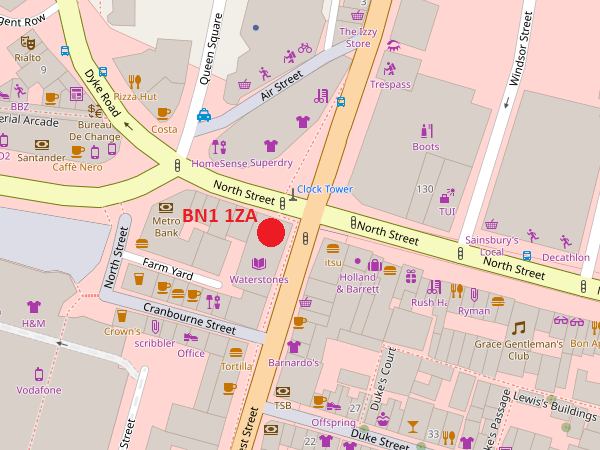
Brighton map

Brighton Palace Pier

The Brighton Palace Pier, which dates from 1899, was the third pier to be constructed in Brighton. It was built to replace the Chain Pier, which had collapsed in 1896 during construction! The Palace Pier is now the only functioning pier in Brighton since the third one, the Brighton West Pier, was destroyed by fire in 2003.

The West Pier

00100lrPORTRAIT_00100_BURST20191228154320262_COVER

Brighton Royal Pavilion

Brighton Royal Pavilion was built as a pleasure palace between 1787 and 1822 for the then Prince Regent, George IV, and after his death both William IV and then Queen Victoria lived there, but it wasn’t really to Victoria’s taste and so was sold to the town of Brighton for £50,000 in 1850.  I don’t know whether it is lit up all year round, or whether it was just for Christmas, but the building looks stunning at night!

Various Brighton shots

It’s fair to say we love Brighton!

IMG_20191228_131341

Hove – Saturday 28th December 2019

We were staying in Brighton for three nights between Christmas and New Year, and were lucky to have exceptionally good weather, so we decided to walk along the seafront to visit nearby Hove to have a late brunch before visiting the Waterstones.  Hove started life as a small fishing village on the south coast. It saw extensive growth in the 1880s and eventually spread far enough to join up with the larger Brighton.  In 1997 the two merged as part of local government reform to form the Borough of Brighton and Hove, but despite this merger the two areas have a distinctly different feel from each other.  Hove has a laidback and almost bohemian atmosphere.   The Waterstones here is located in a pedestrianised area with lots of shops and cafés, and is new to Hove, having opened in November. 

Hove 28.12.19 (1)

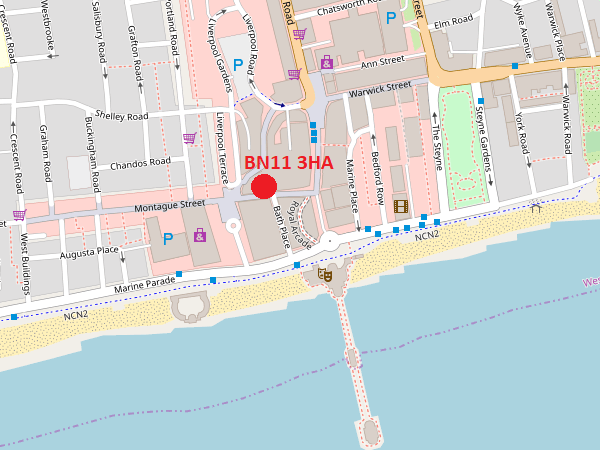
Hove map 1

The Juggler statue

This statue, which is located outside Hove Town Hall, was created by the artist Helen Collis.  Sadly she passed away, but her husband presented the statue to the town in her honour.  The Town Hall opened in 1974 and is in the brutalist style.  It replaced an earlier, red-brick gothic style building which was damaged by a fire.

Below Clockwise from the left:  George Street, the location street of Waterstones, Hove Library, King’s Gardens (just four of Hove’s many, attractive, listed buildings).

(Accreditation for two of the above photos:

Hove library photo – and King’s Gardens photo both by Hassocks5489 – Own work, Public Domain)


Worthing – Friday 27th December 2019

Our next stop was the seaside town of Worthing, which was our destination for lunch on the way to Brighton, but unfortunately we had very little time to spend in the town.  Worthing is a very traditional south coast seaside resort with an award-winning Art Deco pier (which sadly we didn’t have time to visit) and the Regency town has some attractive architecture.  The Waterstones is located in a 1930s style building in the main shopping area.  It is a former Ottakars store, and like others has a mural by Chris Burke (his site appears to be down at the moment) behind the till.

Worthing 27.12.19 (12)

Worthing map

Worthing Pier

Currently reading:  Circe by Madeline Miller

Rustington – Friday 27th December 2019

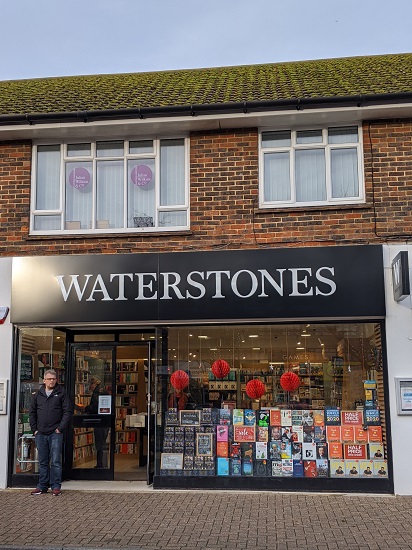
Rustington is a small town in West Sussex situated on the coast.  It has a population of around 14,000 people and, according to Wikipedia, contains a conservation area with the largest number of pre-1850 listed buildings and 18th century flint cottages in the county.  Famous residents of the town include the artist Graham Sutherland, famous for the tapestry Christ in Glory in the Tetramorph in Coventry Cathedral and a portrait of Sir Winston Churchill (which Churchill hated!), and Sir Hubert Parry, who wrote the tune to the hymn Jerusalem – named Rustington after the town. The Waterstones is located in a modern building in the main shopping area. Unfortunately we didn’t have time to explore the town as we had to be in Worthing for lunch. 

Rustington 27.12.19 (2)

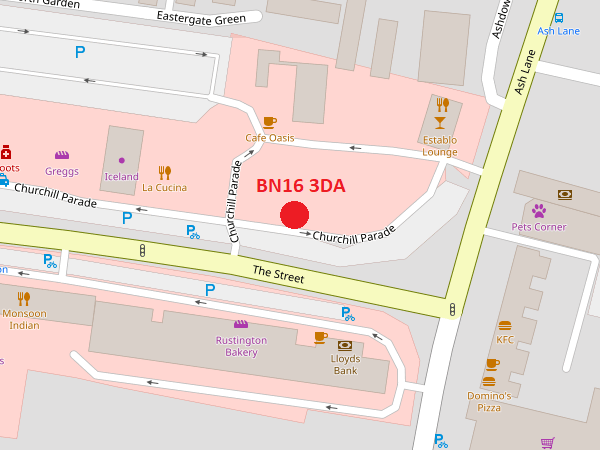
Rustington map

Currently listening to:  Thicker than Water (DCI Logan #2) by J D Kirk

Chiswick – Sunday 15th December 2019

We usually spend a weekend in London before Christmas.  We were due to meet up with friends in Stratford in East London on the Sunday but our plans changed so, as we were staying in Ealing, we decided to visit Chiswick.  It wasn’t an area we knew at all and we both thought it was very nice – it has a village feel about it with a good selection of shops and plenty of cafés and bars.  The Waterstones here is located in a modern building in the main shopping street.

Chiswick 15.12.19 (10)

Chiswick map

Chiswick has been, and still is, a popular choice for the rich and famous – some of its best known residents, past and present, include the artist William Hogarth, poet W B Yeats, novelist E M Forster, musician Phil Colllins, actor Colin Firth and TV Presenters Ant & Dec!  There is a statue commemorating artist Hogarth, who lived in Chiswick for 15 years until his death in 1764.  Designed by Jim Mathieson it was unveiled by David Hockney and Ian Hislop in 2001.

William Hogarth Statue

The Thames at Chiswick

Currently reading: Not a Penny More, Not a Penny Less by Jeffrey Archer

Derby – Saturday 5th October 2019

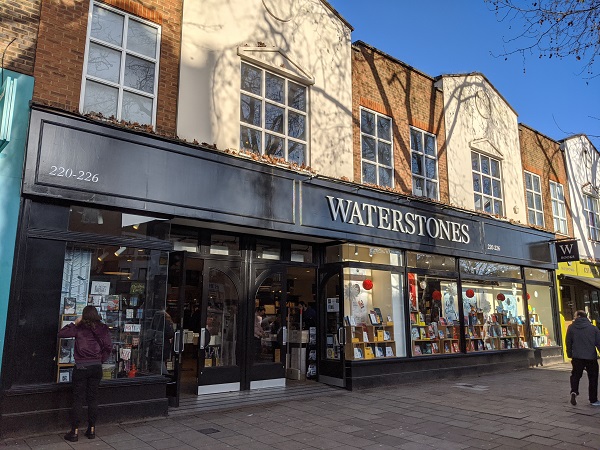
Our last stop on this trip was the city of Derby – the county town of Derbyshire and the site of the world’s first factory.  The county was considered to be the birthplace of the Industrial Revolution.  The Waterstones here is located in a grand building called Babington Buildings, built in 1898 as a Boot and Shoe Emporium, and is set over three floors.  It is a beautiful building both outside and in.

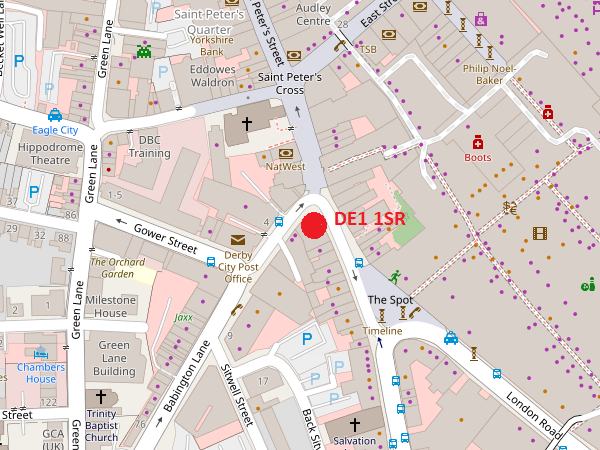
Derby map

The ‘Knife Angel’

We were fortunate to be in Derby for two art installations at Derby Cathedral.  Outside was the National Monument Against Violence and Aggression sculpture, better known as the ‘Knife Angel’.  Made from more than 100,000 confiscated and amnestied blades, he stands over eight metres high and is dedicated to victims of knife crime.

The Museum of the Moon

Inside the cathedral was the Museum of the Moon by UK artist Luke Jerram.   The model of the moon, which was suspended from the ceiling, is seven metres high and at a scale of approximately 1:500,000.  Images of the moon’s surface from NASA cover the surface of the sculpture.  I was lucky to be able to view it as the cathedral was closing for a music event and they stopped people queuing about 15 minutes after I arrived! 

Nottingham – Friday 4th October 2019

Nottingham is a city in the East Midlands which is probably best known for its lace manufacturing and as the home of Robin Hood!  The city, along with Edinburgh, Exeter, Manchester and Norwich, was declared a UNESCO “City of Literature” in 2015 (I had no idea such a thing existed!) because of its connections to D H Lawrence, Alan Sillitoe and poet Lord Byron.  The Waterstones here is set over four floors in an attractive red-bricked Victorian building constructed around 1875 – I took LOTS of photos! 

Ground Floor

First Floor

Second Floor

Third Floor

Nottingham map

The statue of Robin Hood , together with some smaller statuettes of his ‘Band of Merry Men’, stands outside Nottingham castle.  It was created by sculptor James Woodford and gifted to the people of the city by a local businessman.  It was unveiled by the Queen (at the time the Princess Elizabeth) and Prince Philip in 1952. 

Nottingham is famous for its lace production, which was at it’s height in the 1800s but declined after lace fell somewhat out of favour after the First World War. The area known as the Lace Market is now a protected heritage site, and it’s easy to see why with such beautiful buildings as these.

West Bridgford – Friday 4th October 2019

After leaving Lincoln we headed south west towards our next destination of Derby.  Our first stop on the way there for breakfast was the small town of West Bridgford near Nottingham.  The town grew in size considerably after the First World War, having nearly doubled in population from 7,018 in 1901 to 13346 in 1921.  The Waterstones is located on the main shopping street – the building was originally an electrical store owned by a local family who sadly went into liquidation in 2016 after 101 years of trading.

West Briggford 04.10.19 (1)

West Bridgford map

Bridgford Hall

Now a registry office and wedding venue, Bridgford Hall was built in 1768 by Mundy Musters who was ‘Lord of the Estates’ of the area.  It was initially rented out before being bought by Lewis Heymann, the son of the last tenant, a prominent lace manufacturer called Albert Heymann.  The Heymann family lived there until 1923 when the house and grounds were sold to the council and the park created on the land for permanent public use.  The Hall is now one of the most popular civil wedding venues in the county. 

Boston – Thursday 3rd October 2019

We spent the day in the car exploring the county of Lincolnshire driving a circuitous route, first to Grantham, then onto Boston and Skegness before returning to Lincoln in the late afternoon. The Waterstones in Boston is located in a modern building in the main shopping area.

Boston map

St Botolph’s Church

For some reason my I have lost most of the photos I took this day, but I had taken some of St Botolph’s church, known locally as ‘The Stump’. The church’s tower is so tall that it used to be used as a navigation tool by sailors.

Credit for the above images, taken from Wikipedia and used with permission, goes to (clockwise from top left) Martin Clark, the National Churches Trust and BardofL

Lincoln Cornhill – Wednesday 2nd October 2019

The second Waterstones in Lincoln is also in the ‘Downhill’ area and is situated in the Cornhall Quarter.  This area has recently been regenerated whilst retaining some character buildings, including the Old Corn Exchange, built in 1847 and replaced by a larger building in 1879.  This branch of Waterstones is located in the older of the two corn exchange buildings.   

Ground floor

First floor

The Corn Exchange Buildings

The white building is the old Corn Exchange Building, and the red and inside shots are the new.

Stonebow and Guildhall

The Stonebow building was finished in 1520 – the name comes from the Norse word ‘stennibogi’ which means stone arch.  The building houses the Guildhall on the first floor.  It is open to the public, and, according to Tripadvisor, is well worth a visit – unfortunately I didn’t know this when we were there or we would probably have gone for a look around.

High Bridge

High Bridge, which crosses the River Witham, was built around 1160 and is the oldest bridge in the UK to still have buildings on it.  The buildings themselves date from the mid-1500s.