Hexham – Sunday 18th July 2021

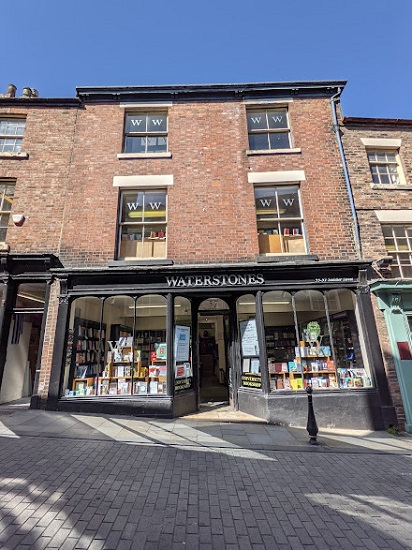
We were going to see my cousin and her husband just outside Carlisle, as they were opening their garden to the public for charity as part of the National Garden Scheme, so on our way over we stopped at Hexham, which is a market town in Northumberland, and is possibly best-known for its Abbey.  The Waterstones is located in a pedestrian street in the heart of the shopping area.

Hexham 18.07.21 (2)

Hexham map

Hexham Abbey

The Abbey was originally constructed in around AD 674 from Roman ruins found locally in the surrounding areas and the building has been added to over the years.  Whilst we were there, the Abbey had an art installation ‘On Angel Wings’, which is in tribute to the many people who have died of Covid-19 and consists of around 4500 origami angels suspended 45ft high in the Abbey’s Chancel and lit from the sides.  It is a stunning display.

Below, clockwise from top left – The Moot Hall (originally a meeting place and the town’s courthouse), Hexham Old Gaol (England’s oldest gaol), the Shambles Covered Market.

My cousin’s garden!

Newcastle – Saturday 17th July 2021

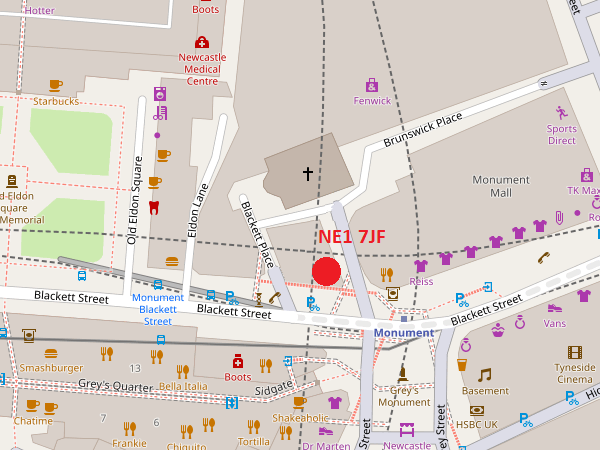
We spent eight nights in Newcastle upon Tyne exploring the area, using the excellent public transport links where possible.  This was our second visit to this wonderful city, which we both love and feel at home in.  I think part of the reason is that we live close to Bristol, which is another great city, and the two places have a lot in common.  The Waterstones is located in an absolutely stunning building designed by Benjamin Simpson from architects Simpson, Lawson and Rayne in 1903 and was used by the company as offices, as well as housing shops and a restaurant.  It’s Art Nouveau building, on the outside, but sadly none of the inside features exist any longer.

Newcastle map

As I said in my Gateshead blog, the two places are linked by seven bridges across the River Wear.  These are Tyne Bridge, Gateshead Millennium Bridge, High Level Bridge, King Edward VII Bridge, Swing Bridge, Redheugh Bridge and the Queen Elizabeth II Metro Bridge.  Of these, my favourites are the iconic Tyne Bridge, the Millennium Bridge and the High Level Bridge, all of which we have walked over. 

Tyne Bridge

Millennium Bridge – the first picture shows the bridge when it has been tilted to allow a boat to pass under it.

Bridge and High Level Bridge

Grey’s Monument, Central Arcade and Grey Street – all in the area called Grainger Town

Newcastle University, Chinatown, View from the Castle – St Nicholas Cathedral on the left, Newcastle castle

Durham University – Friday 16th July 2021

Durham is very hilly and, at the highest point, are the cathedral and castle which overlook the city, and the second Waterstones is also on Sadler Street, at the top of the hill that goes up to these beautiful buildings. The castle wasn’t open but we went into the cathedral to stop for coffee.  They had an immersive art exhibition in the Galilee Chapel called LIGHT by light artist Chris Levine, featuring lasers that pass through a crucifix, bathing the cathedral in a beautiful blue light.  The Cathedral and Castle at Durham were made a World Heritage Site by UNESCO in 1986. 

Durham Uni 16.08.21 (1)

Durham University map

Durham Cathedral and Castle area

LIGHT by Chris Levine

Durham – Friday 16th July 2021

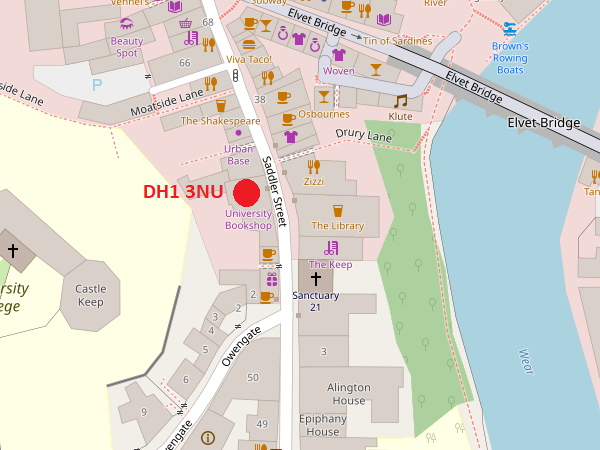
We have visited Durham before and think it’s a great little city, so we headed there for the day by train from Newcastle.   Durham is surrounded on three sides by the River Wear, over which cross three stone-arch bridges – Framwellgate, Elvet and Prebends.  Scottish poet and novelist Sir Walter Scott wrote a poem called “Harold the Dauntless” which mentions Durham several times, and five lines taken from this poem are inscribed on a stone set into Prebends Bridge.  Durham has two branches of Waterstones – this one is set over two floors, and at one point it was a confectioners’ called Earle Brothers.

Durham map

Durham

Clockwise from top left – Prebends Bridge, Sir Walter Scott’s poem, River Wear, Silver Street, The Market Place, Framwellgate Bridge, River Wear

Our friends had been to visit the week before, so set us a challenge of finding the locations they’d taken selfies at, and replicating them!   My phone, which is an android, takes selfies backwards, whereas our friend’s phone doesn’t, but I think they have come out well!

Morpeth – Tuesday 13th July 2021

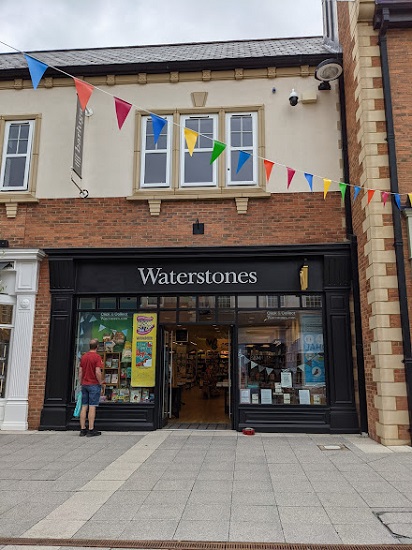
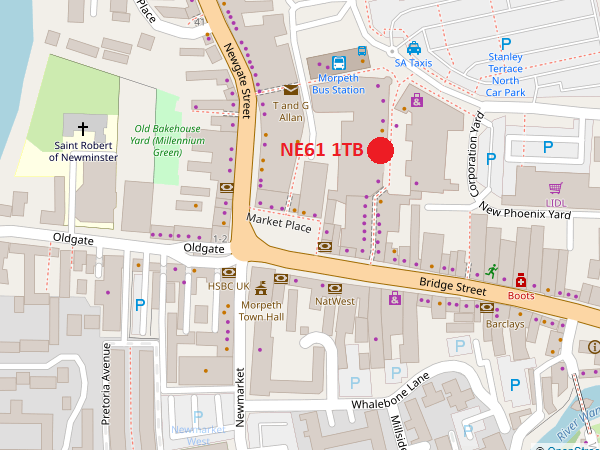
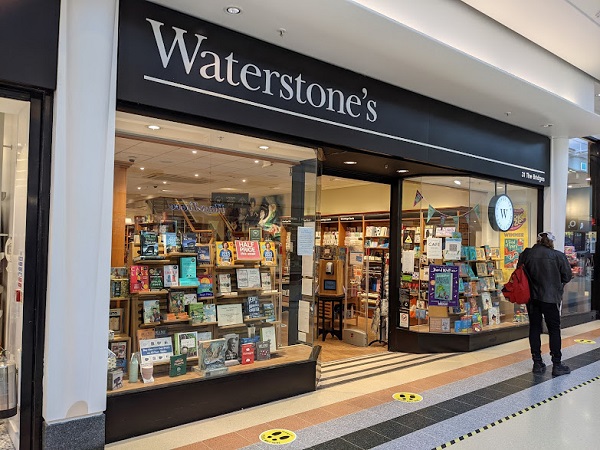
Morpeth is a very attractive market town and is also the county town of Northumberland (although Alnwick dispute this!).  It is surrounded by three sides of the River Wansbeck.  The town also has a bagpipe museum!  The Waterstones is found in the Sanderson Arcade, an attractive and modern open-air shopping centre.  The development, which was opened by the actress Joanna Lumley in 2009, was built on the site of an older, rundown centre.  The developers kept the 1939 façade of an earlier building at one of the entrances on Bridge Street as part of the new arcade.  After leaving Morpeth we headed up to Alnwick and then on to Lindisfarne.

Morpeth 13.07.21 (1)

Morpeth map

Emily Wilding Davison

Emily Wilding Davison, whose parents were both from Morpeth, joined the Suffrage movement Women’s Social and Political Union (WSPU) in November 1906 and was arrested on several occasions for her activism.  She frequently went on hunger strike and she was force-fed nearly 50 times.  She threw herself in front of King George V’s horse at the Epsom Derby in 1913 and died a few days later from her injuries.  She was buried in Morpeth, and a statue to her was unveiled in the town’s Carlisle Park in 2018.

Morpeth

The photograph of Sanderson House was taken by Graham Robson and shared under the creative commons licence.  I have resized it slightly, as permitted in the terms of the licence. Photo © Graham Robson (cc-by-sa/2.0)

Lindisfarne

Lindisfarne, also known as Holy Island, is reached by a causeway which is only crossable twice a day, so visitors have to be careful to take note of the tide times if they don’t want to be stranded there!  Due to these tide times we didn’t have time to see the whole island, but we did manage to see a view of the priory and some of the beautiful beaches before we had to head back. 

Sunderland – Monday 12th July 2021

Sunderland used to be a big shipbuilding area.  The industry is thought to have started in the area as early as the mid-1300s, but went into decline in the 1950s, with the last shipyard closing in 1988.  These days, the Japanese car manufacturer Nissan produces cars in the area and currently have plans for a new £1bn electric car-processing plant in the area.  The Waterstones is in a modern shopping centre.  It has a mural by Chris Burke from when the shop was part of Ottakar’s book shops before they were taken over by Waterstones.

Sunderland 12.08.21 (1)

Sunderland map

Museum and Winter Garden

Sunderland Museum and Winter Garden in Mowbray Park opened in 1879.  The Winter Garden was based on the Crystal Palace in Hyde Park but was destroyed during the Second World War.  A new, very smart, glass extension was added in 2001 as the result of National Lottery funding.  There is a wonderful Walrus statue in the park – based on The Walrus and the Carpenter by author Lewis Carroll, who was a regular visitor to the area.

The photograph of the back of the museum was taken by David Dixon and share under the creative commons licence.  I have resized it slightly, as permitted in the terms of the licence.  Photo © David Dixon (cc-by-sa/2.0)

Gateshead Metro Centre – Monday 12th July 2021

Gateshead is situated on the south side of the Tyne River, and is linked to the city of Newcastle by seven bridges.  The area is known for its architecture, and notable buildings include the Baltic Centre for Contemporary Art and the Sage concert venue and, on the outskirts of the town, is Antony Gormley’s wonderful statue The Angel of the North.  The statue – the largest in Britain – was completed in 1998.  I took the photos below on our last visit to the area.  I had hoped to visit it on this trip, but sadly we didn’t have time. 

The Waterstones here is located in the Metro Centre, which on its opening in 1986, was the second largest shopping centre in England.

Gateshead 12.07.21 (4)

Top row – the Baltic Centre for Contemporary Art, the Sage.  Bottom row – the Angel of the North

Middlesbrough – Saturday 10th July 2021

After an overnight stay in Beverley in East Yorkshire on the Saturday night to have dinner with family we headed towards Newcastle which was to be our ‘home’ for the next eight nights.  On our way we stopped at Middlesbrough.  We had been to the town a few years before in order to visit the Tees Transporter Bridge, so we didn’t spend a lot of time here today – just long enough to visit the Waterstones, which is located in Captain Cook Square in the heart of the town.

Middlesbrough map

Transporter Bridge

The photos below were taken on our previous visit.   We booked a trip to walk across the top of the Bridge after I read about it in Stuart Maconie’s book Pies and Prejudice . It was a brilliant experience and one I would definitely recommend, but unfortunately it’s closed at the moment due to health and safety concerns.   


Leicester Fosse Park – Saturday 10th July 2021

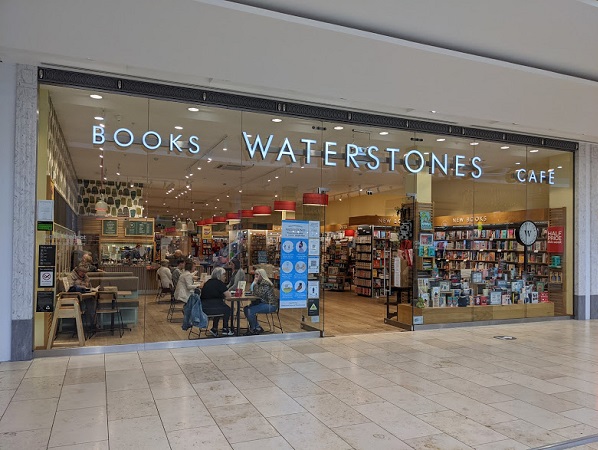
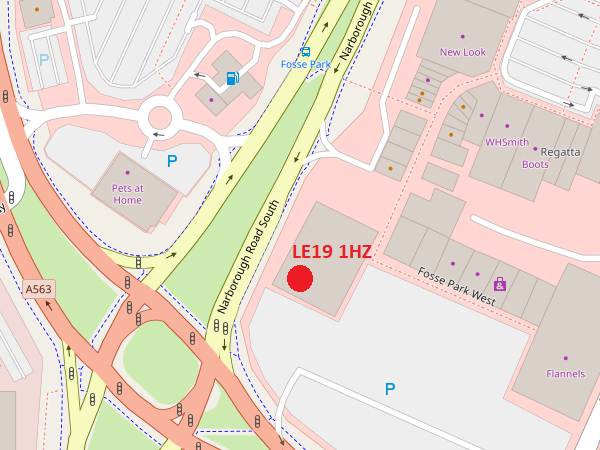
We stopped in Leicestershire overnight on our way to the North East for our holiday, so before heading off in the morning we popped to the Fosse Park Shopping Centre just outside Leicester where there is a Waterstones located inside the Next store – the first of this kind, I believe.  I like this concept and would be happy if they did more shops like this.

Leicester Fosse Park map

Although we didn’t have very long here, I did photograph a few of the Fosse Park Foxes from the sculpture trail.  The foxes are as a result of a competition for designs that show what Leicestershire means to the various artists chosen.   I particularly liked the one dedicated to Alice Hawkins, who was a leading figure in the Suffrage movement in Leicestershire.

Currently reading: Aftermath (Inspector Banks #12) by Peter Robinson

Hanley – Saturday 29th May 2021

Hanley is one of six towns that were merged in 1910 to create Stoke-on-Trent and is generally considered to be the main shopping area of Stoke.  Stoke-on-Trent was once a prolific mining town and is famously known as ‘The Potteries’ due to the many companies in the area producing ceramics from the mid-1700s until late 19th century when there was a considerable decline in the industry.  The Waterstones here is located in The Tontines – built in 1831 as a butchers’ slaughterhouse, it later became a covered market and was used for this purpose until the market’s relocation in 1987.

Hanley map

Arnold Bennett

One of the most famous residents of Hanley is the author, Arnold Bennett – I’ve read and enjoyed a few of his books.  Born into a family of modest means, he worked as a journalist until 1900 when he became a full-time author.  His most famous works feature the fictionalised Five Towns, and are based on this area (he missed out Fenton, the sixth town that was merged into Stoke).  Bennett died aged 63 from Typhoid after drinking tap water in France, and is buried in Burslem, just two miles from where he was born.  The statue below was unveiled in 2017 on what would have been Arnold Bennett’s 150th birthday.